
An SEO platform that runs itself.
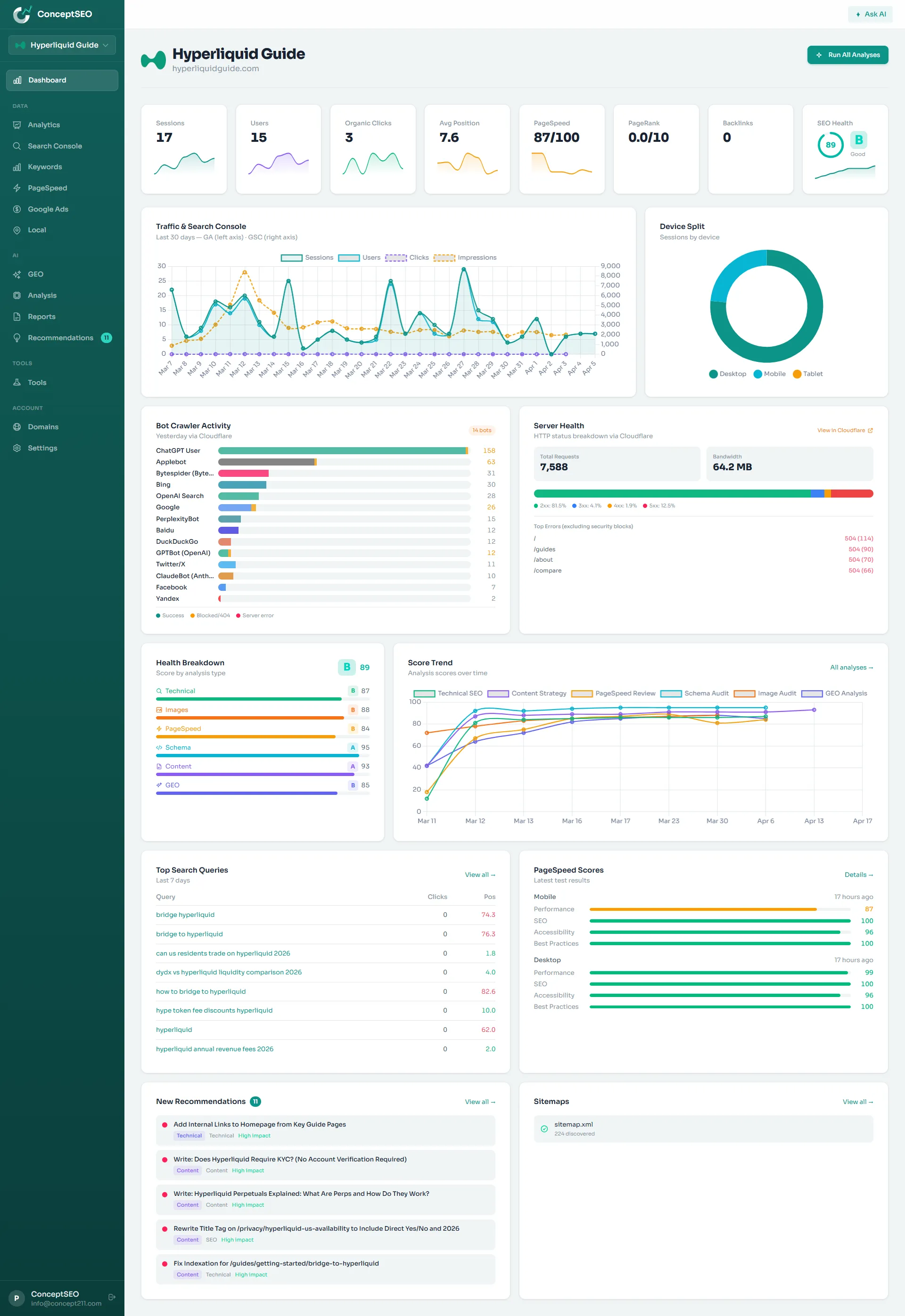
Most SEO work is not clever. It is a long checklist of things that need doing every week, which is exactly why almost nobody keeps up with it. ConceptSEO is our attempt to turn that checklist into software that does the work on a schedule instead. This is how we built it and what it does now.
Why did we build ConceptSEO?
We built ConceptSEO because a technical-SEO and GEO checklist is easy to run once and nearly impossible to keep running by hand. (If the second half of that pair is new to you, what changes between GEO and traditional SEO is the short version.) Crawlability, schema, snippet caps, passage structure, Core Web Vitals, AI-crawler access, and the rest all need re-checking every week across several sites, and catching regressions before they cost rankings is the part that falls apart when a human owns it. So we built a platform to own it instead.
How is ConceptSEO built?
ConceptSEO is a Laravel application backed by the OpenAI and Anthropic APIs. It pulls live data from Search Console, PageSpeed, Cloudflare, and analytics, runs a set of scheduled analyses across each connected domain, and asks the models to turn the raw findings into specific, engineering-ready recommendations rather than vague advice. Each recommendation is written so a developer can act on it directly, and the platform tracks which ones are done. It runs multiple analysis types on a weekly cadence and reports the results as branded, white-label documents a team can hand to a client under its own name.
The part most tools miss
Classic rank tracking tells you where you sit in Google. It says nothing about whether ChatGPT, Perplexity, or Google's AI Overviews are quoting you. ConceptSEO tracks that citation layer as well, so a page that ranks but never gets cited shows up as a distinct problem to fix. That GEO tracking is the same capability behind our Hyperliquid Guide case study, the full method is written up in our GEO methodology article, and it is the engine behind our technical SEO & GEO services.
What has ConceptSEO actually run, and how much?
Here is the platform's own ledger, read straight out of the database on 28 July 2026. The first domain was connected on 8 March 2026, so the numbers below cover roughly four and a half months of continuous operation.
- 10 domains connected, 8 of them active and on the weekly cycle today, an 80 percent active rate.
- 7 analysis types per domain, per week: Technical SEO, Image Audit, PageSpeed Review, Schema Audit, Content Strategy, Internal Linking, and GEO Analysis. Across the 8 active domains that is 56 analyses a week.
- 1,831 recommendations generated across those domains since 8 March 2026.
- 1,683 of them closed, and 1,642 implemented end to end by the agent rather than by a person.
As rates, which is the more useful way to read them:
| Measure | Count | Rate |
|---|---|---|
| Domains on the weekly cycle | 8 of 10 connected | 80.0% |
| Recommendations generated | 1,831 | — |
| Closed | 1,683 | 91.9% of generated |
| Implemented by the agent, no human edit | 1,642 | 97.6% of closed |
| Implemented by the agent, against everything written | 1,642 | 89.7% of generated |
The number worth arguing with is 97.6 percent. It is not a claim that the agent is right 97.6 percent of the time; it is the share of closed work that shipped without a person editing code, and a recommendation the agent could not implement is one that stays open rather than one that fails visibly. The 91.9 percent closure rate is the honest companion figure: 148 of the 1,831 are still open or were deferred.
Those counts come from the recommendation ledger itself, one row per recommendation with a status and a timestamp, not from a survey or an estimate. The per-domain traffic and ranking numbers behind them come from the Search Console, PageSpeed Insights, Cloudflare, and GA4 APIs the platform reads on a schedule, and which of those integrations actually survived production is written up separately, failures included. We do not publish client domains or their individual results here, so treat the totals as the honest aggregate rather than a claim about any one site.
The same ledger, broken out by analysis type, month, and site, is published in full as twenty weeks of weekly measurements across the eight active sites, including the three measurements that came back with zero variance and the limits of what any of it proves.
This very page is inside that count. The site you are reading is domain 10 on the platform, connected 5 July 2026, and it is audited and improved on the same weekly cycle every other managed domain gets. We do not point it at client work and quietly run our own site by hand.
What moved on the sites, not just how much ran?
Everything above is scale. It says how big the system is, not what it changed for anyone. Here is the other half, read on 11 August 2026 across the properties connected to the platform, comparing two consecutive 28-day windows. The count is 16 rather than the 10 in the ledger above, because that ledger was read on 28 July and six more domains have been connected since.
| Measure | 14 Jun to 11 Jul | 12 Jul to 8 Aug | Change |
|---|---|---|---|
| Clicks | 28,038 | 43,100 | +53.7% |
| Impressions | 834,931 | 717,352 | −14.1% |
| Click-through | 3.36% | 6.01% | +2.65 points |
Clicks up 54 percent on impressions down 14 percent is the interesting shape here: the portfolio got fewer chances and converted them at nearly double the rate. It is also the shape you would expect from work aimed at what a page says rather than how many queries it appears for.
Two things keep this from being a claim. One property contributes 96 percent of those clicks, so the total is largely that site's trend standing next to fifteen much smaller ones, and a single strong performer can carry an aggregate on its own. And there is no control group: the platform ran on every one of these sites for the whole period, so nothing here separates its effect from everything else that happened. Totals are summed from page-level rows, which Search Console filters, so read them as floors rather than exact counts.
What it says about how we build
ConceptSEO is the clearest example of how we work: take a repeatable, tedious process, wire real data and AI into it, and ship it as production software that runs without a person babysitting it. If you have a workflow that looks like that, a checklist someone should run every week but never quite does, it is the kind of thing we build well. We build AI-powered web apps like this one for a handful of clients a year, on the same Laravel and model-API stack.
Methodology, and reusing these figures
Every count on this page was read from the ConceptSEO recommendation ledger on 28 July 2026: one database row per recommendation, carrying a status and a timestamp. The window runs from 8 March 2026, when the first domain was connected, to 28 July 2026. Rates are stated against the base they are computed from, either the 1,831 generated or the 1,683 closed. Nothing here is sampled, modeled, or estimated, and no client domain or individual result is included.
You may republish these figures with attribution and a link to https://concept211.com/articles/conceptseo-ai-seo-platform-case-study/. Every heading and every figure above carries a stable id, so you can link to a single number rather than the whole page.
Cite this page
Concept211. “Case study: building ConceptSEO, an AI platform that runs SEO every week.” Published 14 July 2026, updated 18 August 2026. https://concept211.com/articles/conceptseo-ai-seo-platform-case-study/
Is a person doing what software should?
A repetitive, data-heavy workflow that eats someone's Tuesday afternoon every week is the shape of build we take on. The first conversation is about whether it is worth building at all.