
Getting quoted by AI search.
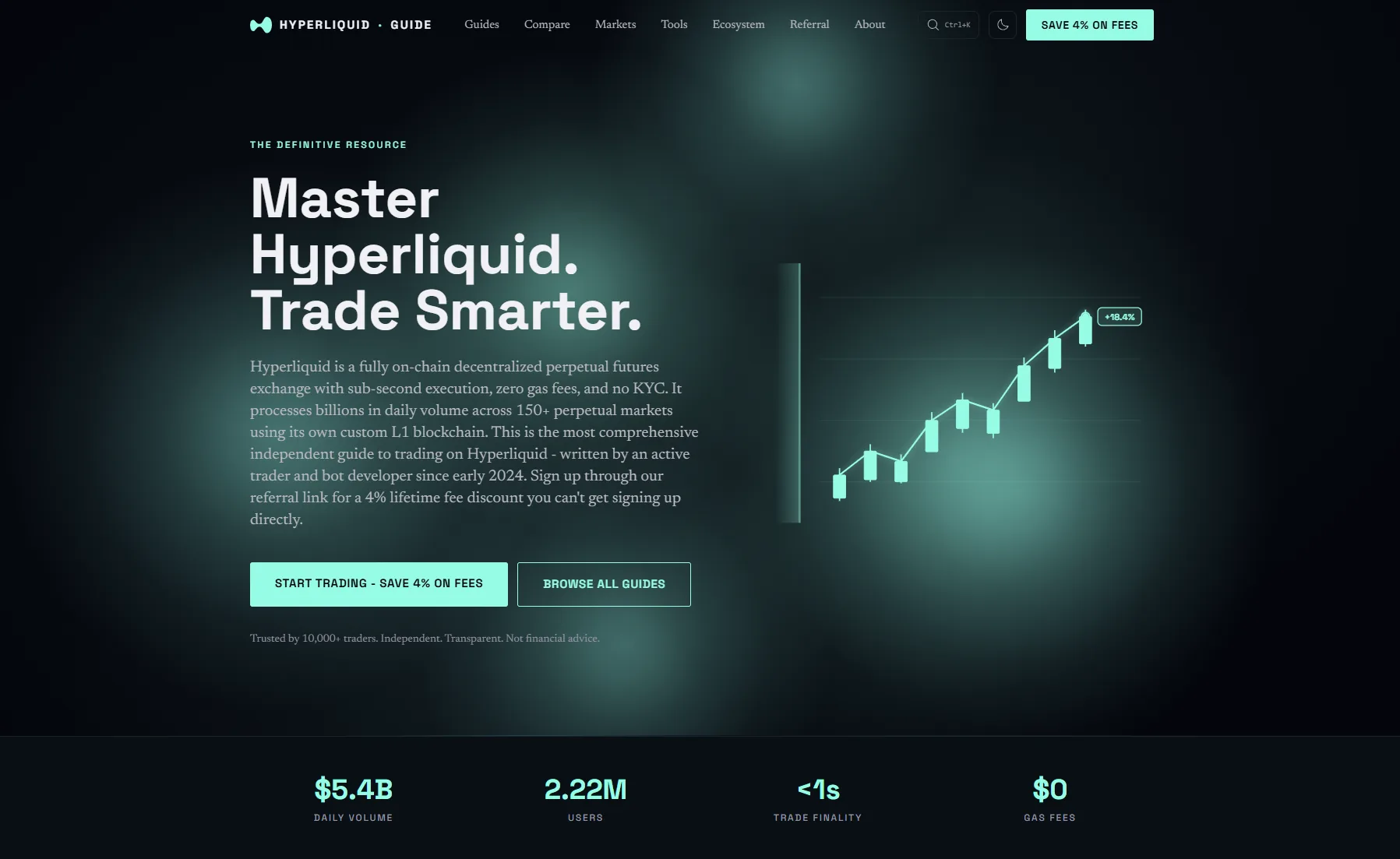
Ask ChatGPT or Perplexity for the best guide to trading on Hyperliquid, and you get a short answer with a few sources under it. If your page is not one of those sources, the reader never sees you. The Hyperliquid Guide is one of our own products, and getting it picked as a cited source is a goal we chase on it directly. Here is what that looked like.
What is the Hyperliquid Guide?
The Hyperliquid Guide is an independent, unsponsored reference to a fully on-chain perpetual futures exchange. It runs to 18 chapters, gets a revision every quarter, and has been read by more than 50,000 people. It is written by an active trader and developer rather than a marketing team, which is exactly the kind of first-hand, specific content that both readers and AI engines tend to trust. The stack is Next.js and TypeScript, server-rendered so the words are in the page rather than assembled by script after load. The same hands-on time with Hyperliquid’s API feeds our crypto trading bot development work.
Ranking is not the same as being quoted
A guide can rank well on its brand terms and still be invisible in AI answers. Classic search gives the reader ten links to choose from. An AI engine reads a handful of pages, writes one answer, and cites the pages it leaned on, and the reader often never clicks at all. So the target is different: you are no longer fighting only for position, you are fighting to be the passage the model lifts into its answer. We wrote up how GEO differs from traditional SEO separately, because the two jobs share most of their groundwork and diverge at the end.
What did you do to get it cited in AI search?
We ran the guide through the same Generative Engine Optimization checklist we use for clients. The full version is written up in our GEO methodology article, but the short list is this. We confirmed the AI crawlers, GPTBot, ClaudeBot, PerplexityBot, and Google-Extended, all get a clean response instead of a firewall block. We made sure the real content ships in the raw HTML rather than filling in with JavaScript, because a crawler that fetches an empty shell has nothing to quote. We restructured key sections into self-contained passages that answer one question completely, so a model can drop a paragraph straight into an answer. We added Article schema, lifted the max-snippet cap to unlimited, and published an llms.txt so the engines have a plain-text map of the site.
How do you know it worked?
AI citations do not show up in a normal rank tracker, which is the exact gap our other product, ConceptSEO, was built to close. It tracks which pages get cited, for which prompts, on which engines, and how that shifts week to week. Watching classic position and citation share together is how we tell the difference between a page that ranks but never gets quoted and one that has started showing up as a source in the answers themselves.
What do the numbers look like today?
The guide was the first site connected to ConceptSEO, on 8 March 2026, and it has been on the weekly cycle ever since. These are the figures as of 28 July 2026, each one checkable against the tool named beside it.
- The AI crawlers get the whole page. Fetching the homepage as GPTBot, ClaudeBot, PerplexityBot, and Googlebot returns HTTP 200 and 162,663 bytes of rendered HTML to every one of them, measured with a plain
curlon 28 July 2026. Before the server-rendering work, a crawler fetch returned a near-empty shell. That byte count is the citability precondition: an engine cannot quote text it never receives. - 519 pages earned Search Console impressions in the 28 days from 28 June to 25 July 2026, taking 35,723 clicks against 588,999 impressions. Source: the Search Console Search Analytics API, pulled through ConceptSEO.
- 629 recommendations generated, 614 implemented since 8 March 2026: the crawler, passage, schema, and snippet work described above, tracked as individual rows in the platform rather than as a project plan.
- Lighthouse mobile on 28 July 2026: 86 performance, 100 accessibility, 100 best practices, 100 SEO, largest contentful paint 3.6 seconds. Source: PageSpeed Insights via ConceptSEO.
The guide is one of the eight sites in twenty weeks of weekly measurements across a live portfolio, and its 614 implemented fixes are the largest single share of that dataset at 36.5 percent. That article carries the portfolio aggregate and the null results; this page carries what happened on one site.
One number we deliberately do not publish is the citation-share series itself. ConceptSEO records which engines quoted which pages for which prompts, week by week, but that data is only as good as the prompt set behind it, and a headline citation count with no prompt list is the kind of figure a reader cannot check. The crawler response, the byte count, and the Search Console totals above are all things you can verify yourself in a minute, which is why those are the ones on this page.
Why this is the proof that matters
Getting sites cited in AI search is a service we sell. The honest way to demonstrate it is to run it on something we own and can talk about in full, rather than a client site we would have to anonymize. The Hyperliquid Guide is that proof: an independent guide, held to the same checklist we would apply to your pages.
Ranking, but invisible in AI answers?
That is a solvable problem with a clear checklist behind it, and running that checklist is the work we do. You keep the citation tracking afterwards.