
Ten networks, one approval screen.
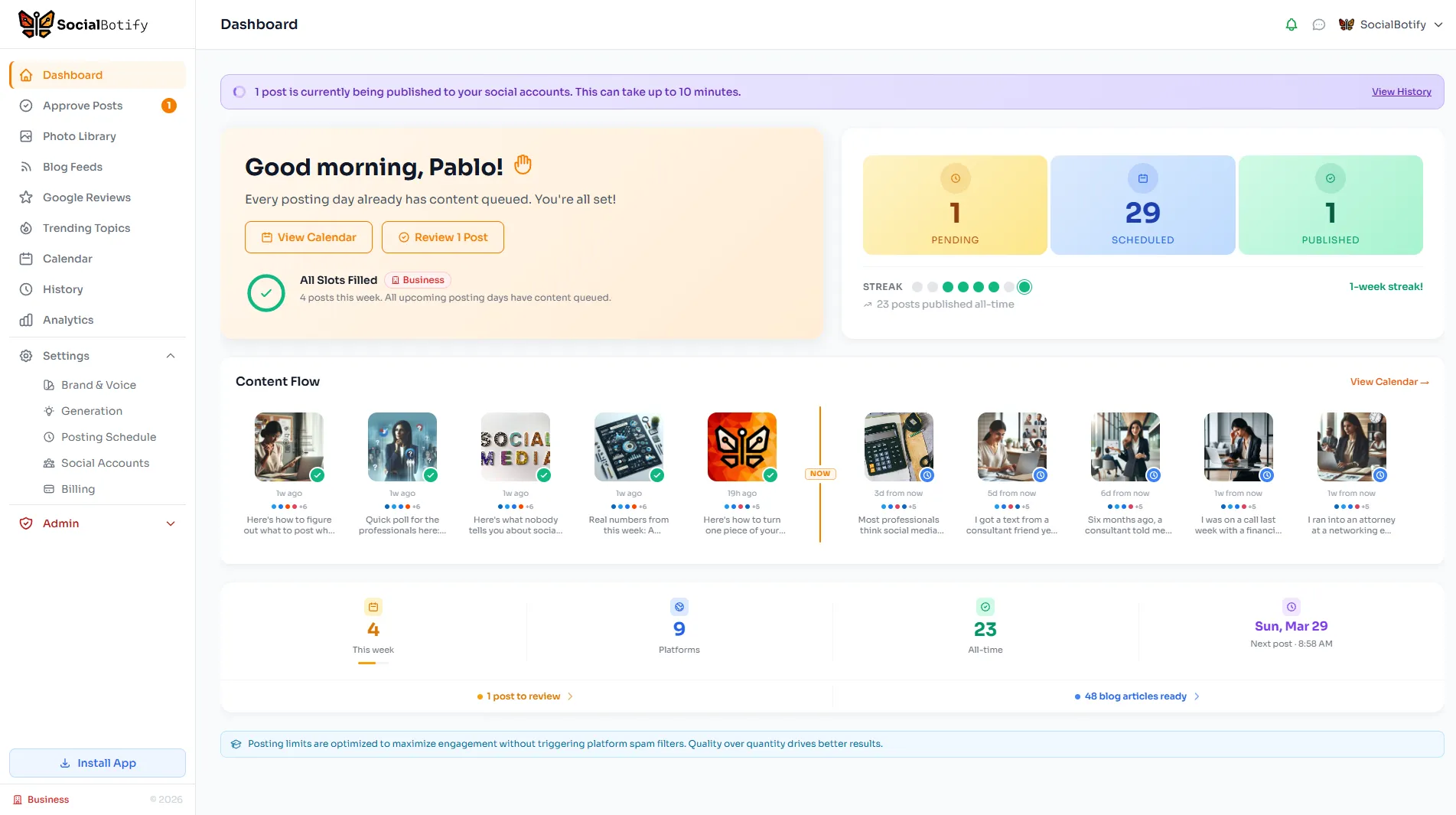
Every social scheduling tool solves the calendar. None of them solve the blank page, which is the part people actually stall on. SocialBotify started from that observation and ended up somewhere more interesting than a post generator.
Status, so the rest of this page reads correctly: SocialBotify is built, live, and deprioritized. We are not putting new development into it, and this is a record of what was built and what it did rather than a pitch for the product. Figures below carry the window they were measured in, and the present tense describes how the software behaves, not how hard we are selling it.
What problem does SocialBotify solve?
An accountant, a lawyer, or a two-person consultancy knows they should be posting. They also have billable work, so the account goes quiet, and a dead profile is worse for credibility than no profile. Buffer, Hootsuite, and Later all assume the words already exist and give you somewhere to put them. The bottleneck was never the calendar.
So the product had to write the posts. That is the easy half, and it is where most AI social tools stop, which is why their output reads like AI social tools.
Why generic posts fail, and what we did instead
A model asked to "write a LinkedIn post about accounting" will produce something fluent, generic, and useless, because nothing in the prompt says what the post is for. Ten of those in a row is worse than silence.
SocialBotify plans before it writes. Every post is generated against a 70/20/10 mix: 70 percent value content that grows an audience, 20 percent authority content that earns trust, 10 percent conversion content that asks for something. Underneath that sit nine funnel-mapped categories, so a scheduled post is never "a post about accounting" but a specific job in a specific slot, written with a named framework such as problem-agitate-solution or a straight piece of social proof. The strategy is a constraint on the scheduler, not a sentence in a prompt, which is the difference between a plan and a wish.
How does it learn a voice?
At setup you give it a URL. It reads the site and derives the industry, the audience, and the tone from what is already published there, which is a far better source than asking someone to describe their own brand voice in a text box. You then adjust: keywords to lean on, words to avoid.
The second signal is rejection. Turning down a post with a reason feeds that reason back into future generation, so the approval screen doubles as the training loop. Most tools treat a reject as a delete. Treating it as data is most of why the output drifts toward sounding like the customer instead of away from it.
Ten networks, one payload
LinkedIn, X, Facebook, Instagram, Threads, Bluesky, Pinterest, Reddit, Google Business, and Telegram, all connected through one-click OAuth. The naive version writes once and posts everywhere, and it reads badly everywhere. Each network gets the same idea adapted to its own character limit and register: LinkedIn takes the professional framing, X takes the punchy one, Instagram leads with the image.
Publishing adds timing jitter on purpose. Posts go out around your preferred times rather than exactly on them, because a feed that fires at 09:00:00 every day announces that nobody is home.
What does it cost the customer, in time and money?
The design target was one sitting a week. You review the queue, edit inline, reject with feedback, or leave auto-approve on and never open it. Plans start at 19 dollars a month with a 7-day free trial and no card up front. Images are either generated on demand or pulled from stock, so a post is never blocked waiting on an asset.
The honest caveat: those are the product’s own figures, published on socialbotify.com, and the review-time number is a design target rather than a measurement we take from every account. We would rather label that than dress it up.
What has the site itself done since launch?
Two consecutive 28-day windows on socialbotify.com, read on 11 August 2026 from the Search Console Search Analytics API.
| Measure | 14 Jun to 11 Jul | 12 Jul to 8 Aug | Change |
|---|---|---|---|
| Clicks | 17 | 21 | +23.5% |
| Impressions | 48,273 | 13,405 | −72.2% |
| Pages earning impressions | 45 in both windows | no change | |
Checked again on 18 August 2026, the pattern had held rather than reversed. Over 19 July to 15 August the site took 19 clicks from 14,466 impressions across 47 pages; over the preceding 21 June to 18 July it took 19 clicks from 42,701. Clicks flat, impressions down about 66 percent. Those two windows are read from the same Search Console Search Analytics API as the table, though the earlier one is derived by subtracting the 28-day totals from the 56-day totals rather than requested directly, so treat it as the weaker of the two numbers.
Impressions fell by nearly three quarters while clicks rose slightly, and we are publishing both rather than the flattering one. Without a daily series in front of us we cannot say whether the first window held a short burst of visibility that decayed or whether the site genuinely lost ground, so we are not going to guess. The click numbers are small enough that a change of four is noise either way. What the product does for the accounts using it is measured inside the product, and those counters are not a before-and-after we can quote here, so we have not invented one. Totals are summed from page-level rows, which Search Console filters, so treat them as floors.
What this means for a build of your own
SocialBotify is a clean example of the thing we keep saying about AI web app builds: the model is the easy part. What made this product work is the planner in front of it, the voice derivation behind it, and treating a rejection as a signal rather than a delete. It runs on Laravel with the OpenAI and Anthropic APIs, the same stack as ConceptSEO, and the same discipline: typed pipelines, guardrails on the output, and cost tracked per feature rather than discovered on the invoice.
Where these numbers come from
Product figures on this page, the ten networks, the 70/20/10 mix, the plan price and the trial terms, are the product's own, published on socialbotify.com, and the weekly review time is a design target rather than an account-level measurement. Search figures are read from Google's Search Console Search Analytics API against the sc-domain:socialbotify.com property, with the window and the read date printed next to every number. Page-level rows are filtered by Search Console, so every total is a floor. Nothing here is modeled, projected, or carried over from an earlier draft.
You may republish these figures with attribution and a link to https://concept211.com/articles/socialbotify-ai-social-post-generator-case-study/. Every heading and every figure above carries a stable id, so you can link to a single number rather than the whole page.
Cite this page
Concept211. “Case study: building SocialBotify, an AI social post generator with a strategy behind it.” Published 28 July 2026, updated 25 August 2026. https://concept211.com/articles/socialbotify-ai-social-post-generator-case-study/
Need output a customer will sign their name to?
An AI feature that has to hold up in front of real people needs a plan in front of the model, not just a better prompt. That is squarely the kind of build we take on.