6–14wks
Scope to handoff
 Concept211
Most AI projects stall at the demo. Something works in a notebook, everyone is impressed, and then it never survives contact with real users, real data, and real load. We build the other kind.
Mostly error handling and cost tracking, plus retrieval that points at your data instead of a generic index. A demo runs on clean input with nobody watching the spend. Production is everything a demo hides, and closing that gap is the whole job.
Six to fourteen weeks from the first scope call to handoff. You get something running in week one: one real path through the system end to end, rather than a polished front end with nothing behind it. Anything we think will run past fourteen weeks gets broken into phases and we scope the first one, because a six-month estimate on work nobody has started is a guess with a number on it.
We start with whether the thing is worth building at all. If we are the wrong shop for it, we would rather say so in week one than in week nine.
One real path all the way through the system. Ugly, but running and instrumented, so the unknowns surface while there is still time to do something about them.
Something real every week. Nothing gets saved up for a reveal at the end, so a change of direction costs a conversation instead of a change order.
Code, deploy steps, and what to do when it breaks at 3am. We stay available for follow-on work, but we do not build in a dependency on us.

The gap between a working demo and a dependable feature is where most AI projects quietly die.Concept211 · How we work
Laravel for the app, Next.js for the front end, OpenAI and Anthropic for the models, Tailwind for the design system. It is the same stack our own products run on, which is the only reason we recommend it: we hit the failure modes ourselves first, on our own time. Most of those failure modes live in the data layer rather than the framework. We wrote up what wiring third-party data APIs into production actually involves separately, including the integration we decided not to build.
ConceptSEO, which we built and still operate. It files and implements its own work every week across every domain we manage, and we are the ones on call for it.
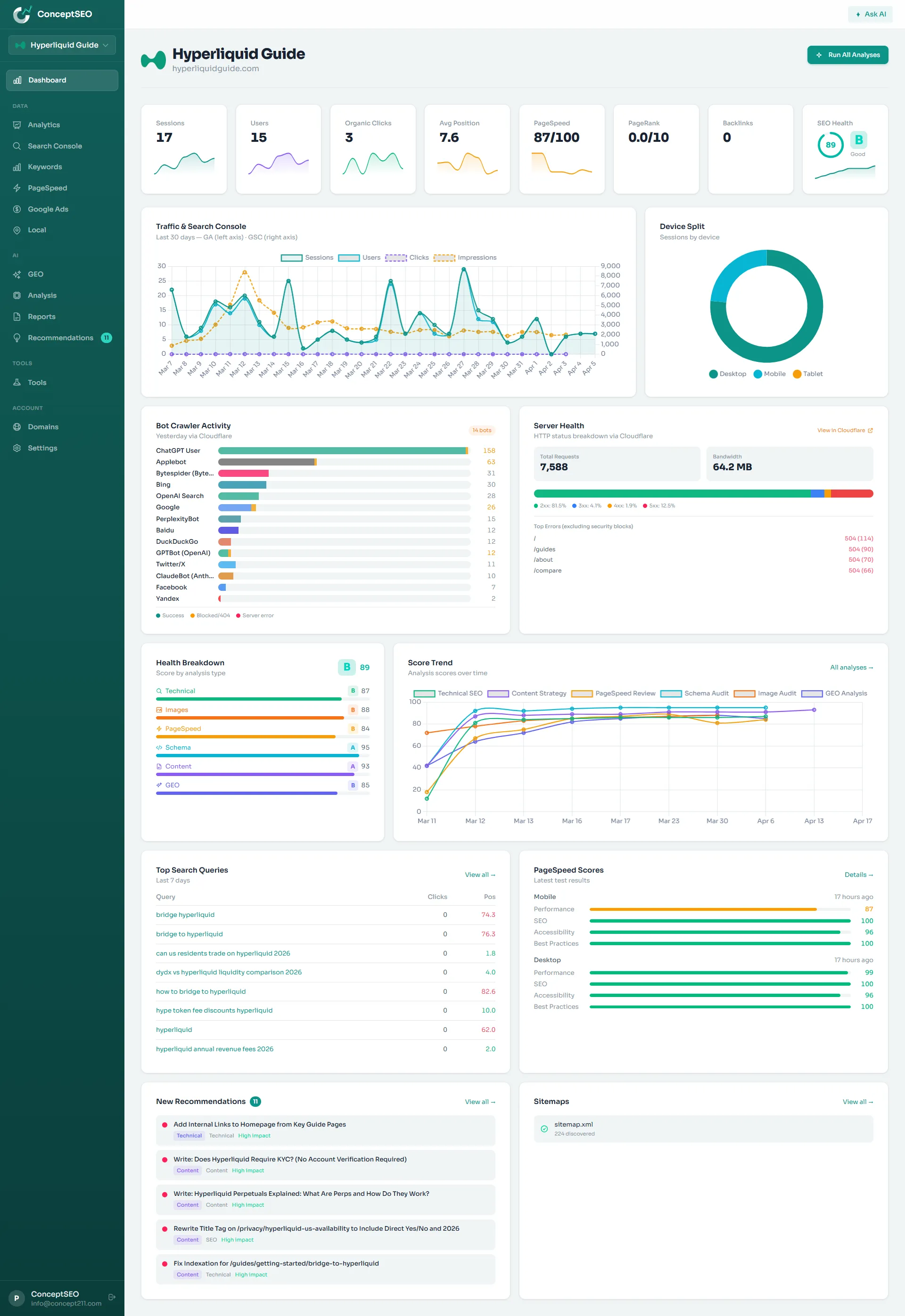
A Laravel and OpenAI/Anthropic platform that audits, scores, and files its own recommendations, then implements most of them without a human in the loop. It is the clearest example of what a production AI build looks like when we are the ones on call for it.
Take the stack claim first, because it is the easiest one to check and the one most agencies cannot survive. Two of the five products this firm runs in production are built on the whole thing, Laravel with both the OpenAI and Anthropic APIs behind it: ConceptSEO and SocialBotify. How SocialBotify derives a brand voice and publishes to ten networks is written up in full. Four of the five run at least one of the four technologies named above. The list is on the homepage with the stack printed under each one, so the count takes about a minute to verify.
Then the throughput, which is the number that says whether a build survives contact with production. Over the 20 weeks to 28 July 2026, ConceptSEO filed 1,831 recommendations across eight connected domains and closed 1,683 of them, and 1,642 of those closures shipped end to end by the agent rather than by a person editing code. Counts read from the platform's own recommendation ledger, one row per recommendation with a status and a timestamp, and published in full in the twenty-week benchmark.
The page you are reading is inside that number. This site is domain 10 on the platform, connected 5 July 2026 and audited on the same weekly cycle as every client domain. As of 25 August 2026 it has taken 114 recommendations, closed 97, and every one of those 97 was implemented by the agent. We do not point the platform at client work and quietly run our own site by hand.
The caveats travel with the figures. Eight domains is a small sample and it is not a random one, since four of the eight are our own properties. There is no control group behind any of it, and the ledger counts work implemented rather than work that provably moved a metric. Those limits are stated in the write-up rather than left for you to find.
Four things, near enough every time: what the stack is, how long it takes, what actually ships, and what happens once we hand it over. The answers below are the same ones we give on the call. Six to fourteen weeks, code and runbooks at the end, and nothing engineered to keep you calling us.
Ask us something elseLaravel and Next.js on the front, wired to the OpenAI, Anthropic, and Gemini APIs on the back. This is the same stack behind our own products, so you get patterns we already run in production rather than something we are trying for the first time on your budget. When a job needs on-chain data, real-time delivery, or a native desktop surface, we reach for the tool that fits instead of forcing everything through one framework.
Six to fourteen weeks from first scope to handoff. The short end is a focused feature with a model in the loop. The long end is a full application with retrieval, an admin surface, and cost controls behind it. Anything we think will run past fourteen weeks we break into phases and scope the first one, because a six-month estimate on a project nobody has started yet is a guess with a number on it.
The full path from your data to a model and back into your product: typed pipelines, retrieval over your own content, guardrails on the output, usage and cost tracking, and a UI that makes the AI feel like a feature rather than a science experiment. Nothing lands as a proof of concept you still have to productionize.
You get the code, the runbooks, and a system your team can run without us. The runbooks are the part people skip: how it works, how to deploy it, and what to do when it breaks at 3am. We stay available for follow-on work, but we do not build in a dependency on us to keep it running.
Ready to leave the demo stage?
If you have an AI feature that has to survive real users, real data, and real load, that is exactly the kind of build we take on. The first conversation is about whether it is worth building at all.